


As the advertising industry moves into 2026, the conversation around AI, data, and automation is finally shedding its novelty and stepping into accountability, where performance, partnerships, and real differentiation matter more than ever before.
Read on as four executives from Cognitiv, the leading advanced performance partner powered by deep learning, share how they see this next chapter unfolding across areas like autonomous decisioning, the true role of AdCP, the rise of AI-powered curation, and a new, intelligence-led era of mergers and acquisitions (M&A).
.png)
AI Will Become The Brain Behind The Brands
After two years of buzzwords and cosmetic LLM wrappers, 2026 marks an inflection point. The advertising industry will start demanding real results, and AI will become the brain behind the brands.
Marketers will not just buy AI tools, they will push for autonomous systems embedded directly in the programmatic stack. Algorithms that evaluate, price, and optimize every impression in real-time without human prompting. Systems that do not just execute but actually think.
It is likely we will see early experiments with AdCP (Ad Context Protocol) but at this point it does not make DSPs or SSPs smarter on their own. Real innovation is on the horizon as AI begins operating beneath the surface, embedded directly into the systems themselves, observing market dynamics, learning patterns, and making split-second decisions no human could replicate.
More companies will look to options other than containers that allow larger, faster algorithms to be run, such as co-location, or the platforms themselves will enable much larger architectures to be run within their own. Brands will look to integrate these at the enterprise level, so these platforms can directly activate their first party data in a way that is unique only to their brand.
The future of AI in advertising will be written by tech powerhouses growing through genuine deep learning innovation. Companies with proprietary algorithms delivering measurable impact will thrive.
2026 will prove that AI can truly reduce waste, increase performance, and reshape media buying. When the fancy AI buzzword wrappers come off all the fast-to-market lookalikes, it will become clear which platforms have built a real brain behind the brands with transformative intelligence, and which are still relying on lever-pulling automation.
AdCP Will Streamline Operations, Not Redefine Performance
In 2026, the ad industry will begin to understand what AdCP (Advertising Context Protocol) really is, and what it is not. AdCP has the potential to streamline workflows: reduce manual steps, improve coordination between tools, and give AI agents a standardized way to interact with today’s buying systems. That’s valuable. But it’s not a performance breakthrough.
AdCP doesn’t change how decisions are made inside the DSP. It does not alter the bidding logic, prediction models, or optimization layers that actually drive return on ad spend. It is fundamentally an interoperability and communication layer that is useful for efficiency, but it is not a new buying engine. Agencies hoping AdCP alone will unlock performance gains will find that what they really purchased is smoother operations, not competitive advantage.
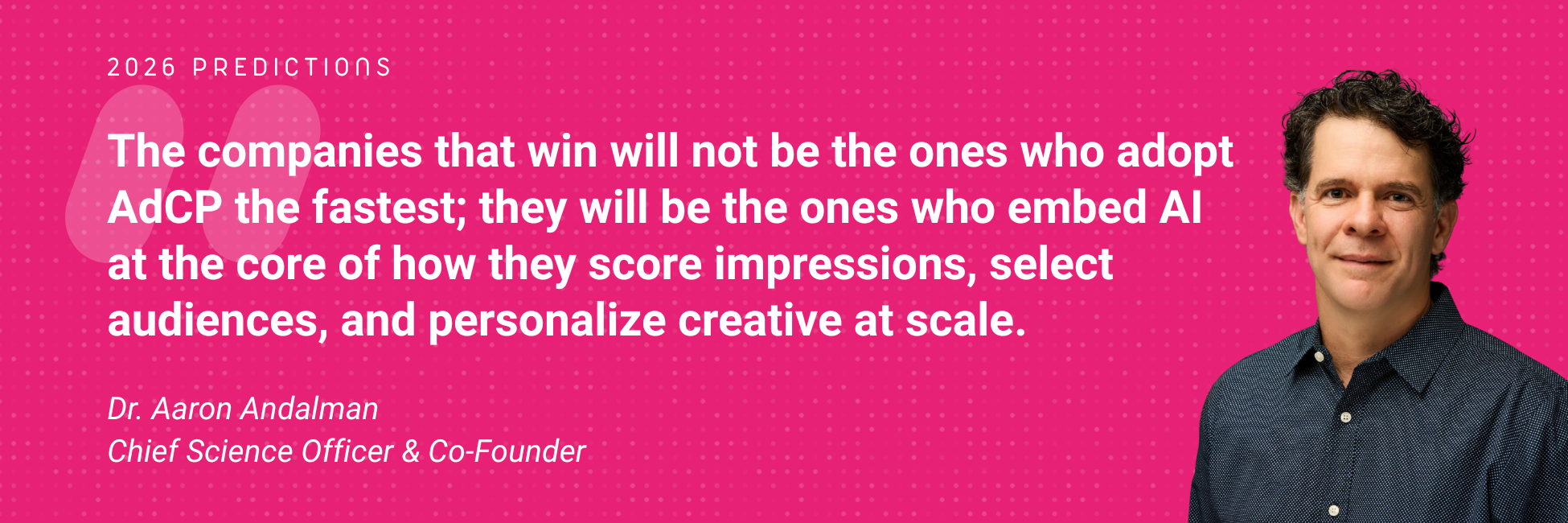
The bigger opportunity for 2026 lies elsewhere. Modern AI now has something advertising systems have never had before: broad world knowledge, deep content understanding, and the ability to reason about audience intent with almost human-like intuition. That capability can move performance, but only when it is integrated directly into the decision-making stack, not wrapped around it. The companies that win will not be the ones who adopt AdCP the fastest; they will be the ones who embed AI at the core of how they score impressions, select audiences, and personalize creative at scale.
M&A Will Shift From Scale to Intelligent Differentiation
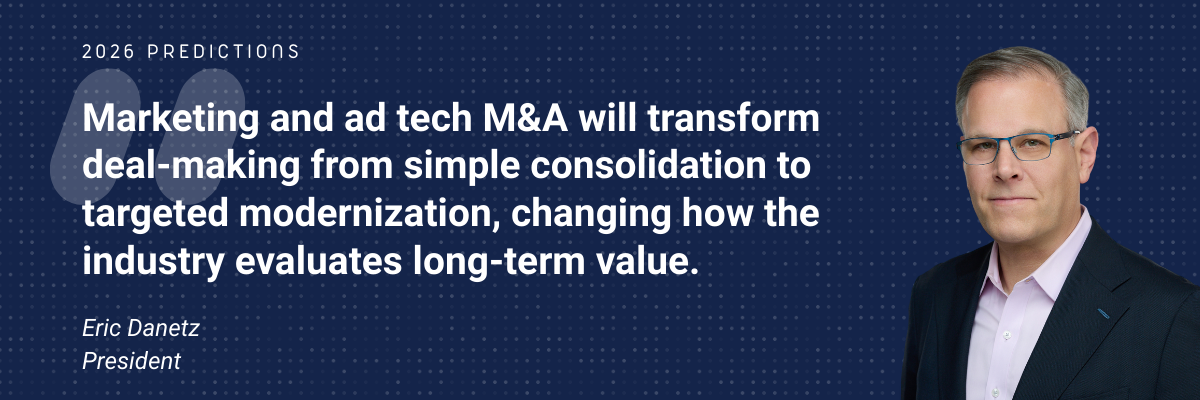
In 2026, marketing and ad tech M&A will transform deal-making from simple consolidation to targeted modernization, changing how the industry evaluates long-term value. Strategic buyers will look for companies with differentiated intelligence, real-time adaptability, and proven performance, using acquisitions to close structural gaps in contextual relevance and measurement.
As technology advances faster than traditional players can evolve, AI will no longer be a "nice to have," but a necessary requirement.
This will also present a new opportunity for smaller players whose technology can deliver proven outcomes where others have fallen short. Whether they choose to be acquired or continue to grow on their own, they will gain a significant foothold in influencing how the industry does business. Those with proven intelligent performance and agility are positioned to create a step-change for years to come.
AI-Driven Curation Will Become a Primary Engine of Programmatic Value
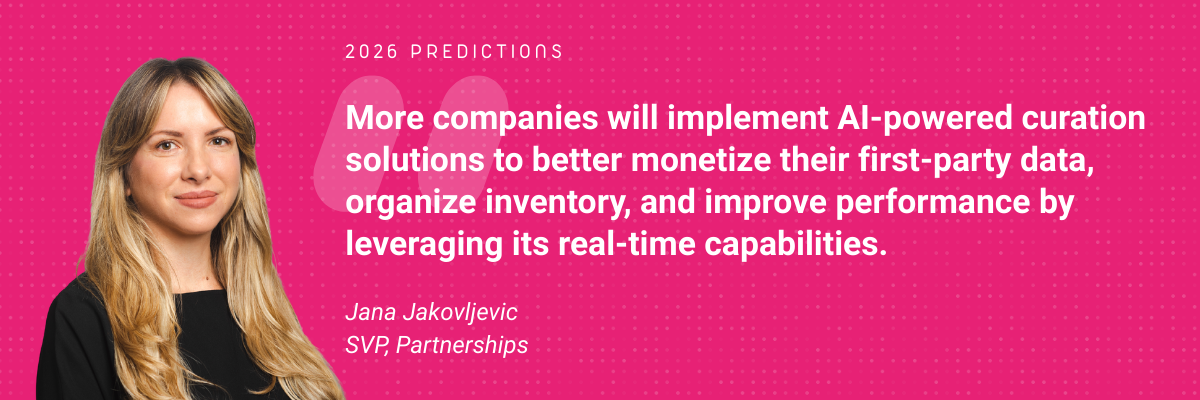
In 2026, more companies will implement AI-powered curation solutions to better monetize their first-party data, organize inventory, and improve performance by leveraging its real-time capabilities. AI-driven curation will become the norm to keep pace with the demand for innovation, custom solutions, and the intense competition for consumer engagement. It will be a core growth strategy for media companies, data owners, and retail media networks.
Curation has created a pathway to introduce revenue-share models, a shift that is attractive for data-rich companies that have been previously constrained by flat CPM pricing for their segments. In 2026, curation will not just influence where ads run; it will shape how value is created across programmatic.
Where Will These Predictions Lead?
As 2026 unfolds, and AI in advertising graduates from merely presenting possibilities to redefining best practices, our industry must consider what actually drives results.
Some advances will make advertising easier to operate, others will make it more cost-effective to deploy, but which will be the innovations that meaningfully change how we leverage AI in advertising for good? Only time, persistence, and partnership will tell.


