


Every hotel booking follows a valuable moment of decision, and that moment leaves a trail. Cognitiv’s Deep Learning Advertising Platform (DLAP), built to catch shifts in behavior as they happen, lets us understand that trail and act on it while that purchase decision is still being made. For advertisers, that insight could be the difference between reaching a traveler and being left in the dust.
Where standard targeting sees a traveler as a static profile, our deep learning models detect how behavior shifts minute to minute. That is what turns browsing data into bookings.
Here is what that trail looks like, and how Cognitiv positions advertisers to capitalize on it.
Interest Spikes in the Final Hour
In the 24 hours leading up to a hotel booking, traveler behavior spikes hard, right before their purchase decision. Searches for "hotels near me" jump 9x above baseline, "suites" 7.4x, and "inn" 6.6x, all concentrated in the final hour before a decision gets made.
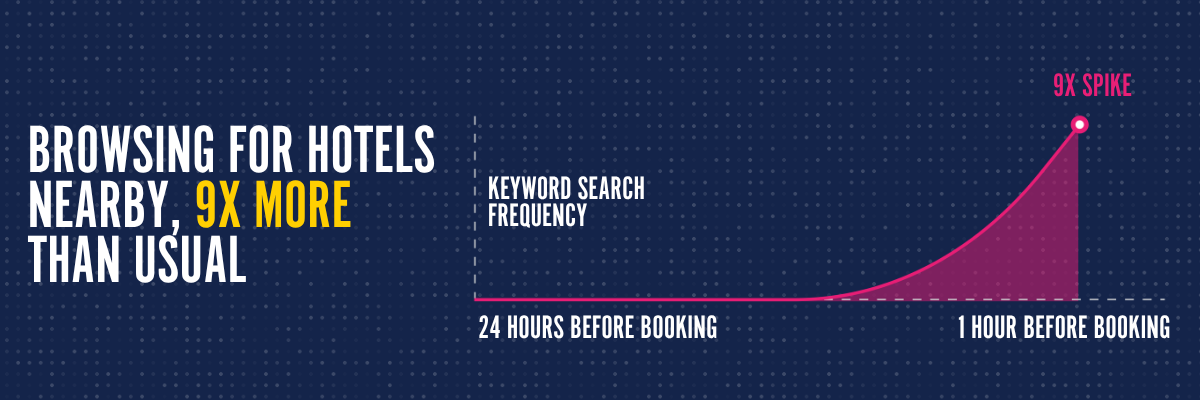
Interestingly, the decision to book is not locked in a day ahead and executed later. Regardless of the web browsing that happens earlier in the traveler’s journey, their real evaluation is still underway in the final hour before they book.
At the property level, the pattern is even sharper. Interest in a single hotel spikes up to 10x compared to the preceding 23 hours combined, as the traveler narrows in and makes the call.
Not all travelers behave the same, though.
Mid-scale travelers comparison shop, keeping competitor properties in the mix as they browse. For mid-scale advertisers, the final hour is contested.
Luxury travelers do not. Working with a luxury hotel chain, Cognitiv's models surfaced pre-booking interest that stayed concentrated on the brand's own properties rather than spreading to competitors. For luxury advertisers, that shifts the job from winning a traveler off a competitor to getting the timing right.
Where the Budget Wins or Loses
For most travel marketers, the pre-booking window has been a black box. Standard measurement was not built to see inside it, so the hour before a booking gets written off as too late to matter and the budget shifts toward earlier phases where activity is easier to observe and attribute. The tradeoff is reaching travelers while they are still browsing casually rather than when they are deciding.
Our data says otherwise. Analyzing hotel browsing behavior in the hours before booking, Cognitiv's models found that the decision is still in motion in that final hour, and the property-level spike is one of the strongest signals of real intent available. That spike is also one of the last to appear, and most platforms arrive after it has passed.
Our Custom Algorithms product is built to read that spike. The model extracts meaning from signals other platforms overlook and acts on them while the decision is still being made, so the spend lands on the traveler who is about to book rather than the one who already booked with someone else.
For travel advertisers and many others, Cognitiv captures time-sensitive signals that others miss. Connect with us to learn how.


